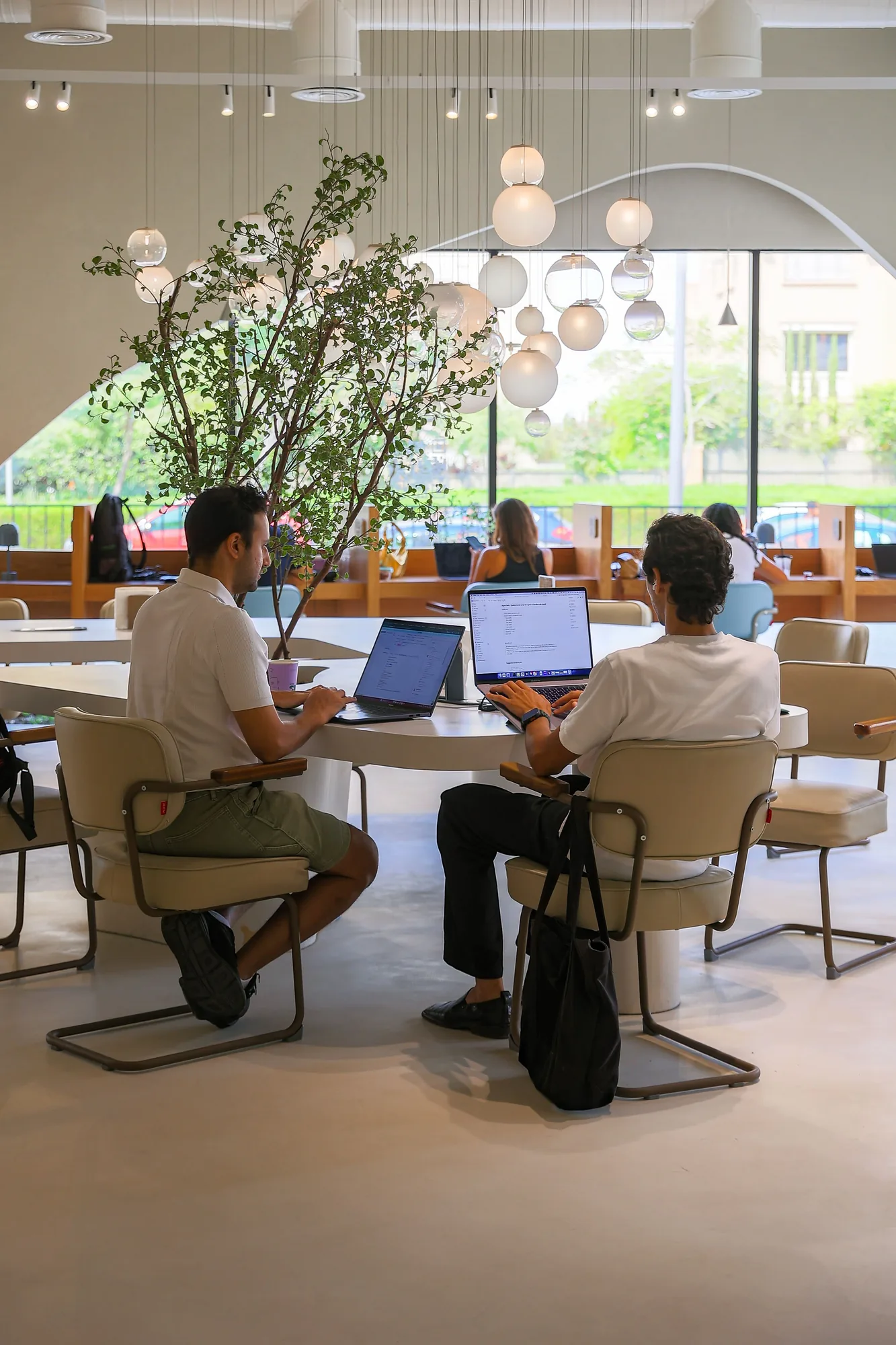
A view from the operator’s desk: where occupancy trends, tenant expectations, and hospitality are converging across MENA.
Running a co-working space teaches you things that no market report can. You learn them at the front desk, in the conversations tenants have before they sign and in the ones they have when they are thinking about leaving. You learn them from watching how a space fills up on a Tuesday morning and empties on a Thursday afternoon. You learn them, slowly, from paying attention.
That is the perspective this piece comes from. Not a forecast built on survey data, but an operator’s reading of a market that is changing in ways that matter for developers, investors, and anyone building workspace in the region.
The numbers behind the shift
Sources: Next Move Strategy Consulting, 2024 · Cushman & Wakefield · DropDesk, 2026
A market at an inflection point
Co-working in MENA is not the same industry it was five years ago. The spaces that defined the early market — built around density, low price points, and the novelty of a shared address — are losing ground. Not dramatically, not all at once, but consistently and in one direction.
What is replacing them is more interesting. Spaces built around how people actually work. Around the quality of the environment, the calibre of the companies inside it, and a level of service that treats members as guests rather than subscribers.
The pandemic did not create this shift. It revealed it. When remote work became the default, people had a choice about where to go. The spaces they chose were the ones worth choosing. The rest found out, quickly, that cheap square metres were not enough of a reason.
The numbers reflect this. The Middle East co-working market is projected to grow from USD 274.6 million in 2023 to over USD 1 billion by 2030, at a CAGR of 21.1%. Egypt alone is forecast to grow at 15% annually, making it one of the faster-growing markets in the region.
The operators who will win over the next five years are the ones who understand that hospitality is infrastructure, not decoration.
— Mohamed Samy, Founder and CEOWhat enterprise tenants are actually evaluating
The conversation around co-working has changed at the enterprise level. Fast WiFi and a well-designed common area were once enough to stand out. Today those are the price of entry.
What enterprise tenants now evaluate is harder to put in a brochure. How consistently is the space managed? What is the quality of the other organisations in the building? Does being here reflect well on us as a company?
That last question matters more than most operators realise. A company like Johnson & Johnson or Cushman & Wakefield is making a statement about itself when it chooses where its team works. The workspace becomes part of how it recruits, how it retains, and how clients experience the company when they walk through the door.
According to Cushman & Wakefield, 55% of global corporations now utilise flexible office solutions, with 17% planning to increase their use. In Dubai, 40% of flexible workspace users in 2024 were enterprise clients requiring tailored solutions for teams of 20 or more employees.
Where hospitality and real estate converge
The most consequential change happening in MENA co-working is not about space design or technology. It is about who is running these spaces and how they think.
The best operators in the region right now are not property companies that added a service layer. They are people who understand hospitality and applied that thinking to a physical workspace. The difference in output is significant.
A hospitality operator asks different questions. Not just ‘is this space functional?’ but ‘does this space make people want to come back tomorrow?’ Not just ‘how do we fill seats?’ but ‘what kind of community are we building, and does it make each member’s work better?’
That distinction drives every decision at Soil Spaces, from how the space is designed to how the team is hired to how a member concern is handled at 6pm on a Thursday. It is not a positioning statement. It is an operating principle.
What this means for developers and investors
The co-working market in MENA is still early relative to what it will become. But the shape of what wins is becoming clear, and it is worth paying attention to now.
For developers, the operator you choose for your workspace floors matters as much as the address. A hospitality-led operator improves occupancy, extends tenancy, and protects asset value in ways that a volume operator cannot. The space performs better because the experience is better.
For investors, the question to ask is not ‘how many desks?’ but ‘what is the member retention rate, and why?’ Retention is the metric that separates a hospitality concept from a commodity product. It is also the metric that compounds over time.
The operators who survive the next five years in MENA will not be the ones with the most locations. They will be the ones who understood early that a workspace is not a real estate product with a service layer on top. It is a service product that happens to require real estate.
Occupancy follows experience. Experience follows intent. And intent has to be there from day one.
Sources
- Next Move Strategy Consulting (2024). Middle East Co-Working Space Market Analysis 2024–2030.
- Cognitive Market Research (2024). Egypt Coworking Market Forecast.
- Cushman & Wakefield. Global Flexible Office Adoption Report.
- British Chamber of Commerce Dubai (2024). The Rise and Benefits of Flexible Workspaces in Dubai.
- DropDesk (2026). Coworking Statistics & Trends for 2026.